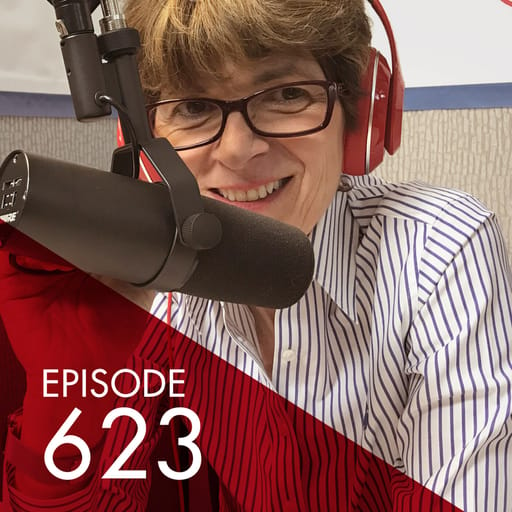
Transcript 0:00 [upbeat music] Welcome back to the Peggy Smedley Show, the podcasting voice of IoT and digital transformation. Hello, listeners, and welcome back to the Peggy Smedley Show. 0:14 My next guest is going to be a new regular on the show, and she has become a public speaking expert as a direct result of both the triumphs and failures. 0:23 She also teaches leadership communication at the Wharton School and runs a woman's leadership development program. Please welcome Barbara Roche, managing partner at Speakwell Partners. Barbara, welcome back to the show. 0:38 Hey, Peggy. It's great to be with you again. So now, Barbara, let's talk about some of those leadership challenges we face today because as we look at society, there's a lot of them. 0:49 So let's start, start off the show with that. There are. Yeah, let's start with that [laughs] 'cause there's so much there. I wanted to throw a term out to your listeners they may not have heard before. It's called VUCA. 1:01 V-U-C-A. VUCA. And it's from the military, but essentially means volatile, uncertain, complex, and ambiguous, and we live in a VUCA world. 1:13 So the first challenge right now is the constant change, and just listening to your previous guest, I was thinking to myself, "Wow." 1:22 [laughs] The digital twin world and everything that was he, he was talking about as an example. And so what happens is if you are not effective at change management and change leadership, y- everybody will suffer. 1:35 So when we look at this VUCA that you described, you know, what do we need to do to kinda overcome some of those challenges because it seems like there's a lot of them [laughs] right now whether whatever part of the role you serve in a, in a business. 1:50 That's right. And what I would say is you may not be able to control the speed and the volume. That's the V. And that's partly the industry, it's partly technology, and, and, and really nothing's predicab- predictable. 2:05 And so let's go to uncertainty because I really feel like this is the most important one for any leader, any people manager, no matter what industry you're in. 2:15 The brain craves certainty, and when the brain can't make that pattern and that prediction, we go into what's called a threat state. We're off our game. 2:25 So every leader can say things like this: "Well, I can't answer that particular question, but I promise you as soon as we have new information we will get back to you immediately," or, "I will get back to you once I go to this meeting." 2:40 Whatever it is that can create some certainty, 2:44 use it because then you're calming the brain down to handle the complexity and maybe even the ambiguity, which leads me to the second strategy leaders can make around the A for ambiguous, which is 2:57 how can you lower frustration and how can you help people gain clarity on where things are headed? And what that means is, and I know people are very busy, but they gotta hear this, over-communicate. 3:11 Don't cancel your one-on-one meetings. Don't rely only on email, and have time for questions. Don't rush out of a meeting because you didn't think about what your team needed. Isn't that today's society though? 3:27 You know, with all of the texting we do- Yeah... and everything, we just figure email and texting's the way to go. I mean- Yeah... that's the way our mobile society has created us. 3:37 That's right, and things like Monday and Slack and all these tools and apps that people love, I now have a client who in the span of three years went from, "I can't live without Slack," to, "I gotta turn my Slack channels off." 3:51 And so you, you see how we can fill a void really quickly [laughs] because that was only three years worth of time. So never, ever lose sight of the fact that followers, and that's what we could call anybody who is 4:06 trying to lead a group of people. We will call them followers, the people who choose whether to follow you or not. 4:13 What they need is face-to-face, and if you have a virtual team, I understand that's sometimes hard, so at least electronically where you have a video camera. 4:22 And you'll see now with apps like Zoom and Skype where I find that my clients make it a requirement that people's cameras are on because it enhances that connection. 4:35 So what characteristics then do these great leaders have? Are they outspoken? Are they charismatic? What, what do they really have that make a good leader right now besides what you say not to be having- Right... 4:48 this ambiguity that we... But are there certain characteristics of a great leader? 4:53 There really are, and there are some foundational characteristics that I believe cross every industry, and then of course there are some that will be unique to certain industries, like pharma will have a certain thing that, let's say, construction doesn't need. 5:07 The foundational aspects are a shift from command and control, the old days, I tell you what to do, you do it, I monitor that you did it and how well you did it, moving to two new words. 5:22 So what's replacing command and control is guide and inspire. Guide and inspire. 5:29 The guide is I'm gonna care about your professional development, and I'm gonna guide you through the expectations of what a quality job means to us on our team. I'll give you input and feedback and support. 5:42 And then the inspire is I'm gonna show you how much I care about this organization, this team, and the vision that we all have and where we're trying to get to. So lose the command and control. Add guide and inspire. 5:59 So now I'm gonna ask this- And then what I would say secondly... Okay. Go ahead. Go ahead. No, go ahead.I was going to say, the second thing is, for a foundational, is you can't say enough about self-awareness. 6:10 So a leader who's clueless, has many blind spots- [laughs] -will not have very many followers for very long. So what can you do to enhance your own self-awareness of your strengths? 6:20 Any areas that need work, where you could modify. Everybody wants to work for a leader who's constantly learning and evolving. 6:29 So that was gonna be my question, is be-- do we think we have enough leaders who want to inspire and mentor the next generation? 6:37 [laughs] Because we have a generation that wants that guidance but doesn't really know that they need it, because we've kind of flipped that kind of thing where the younger generation doesn't want to teach, yet the older generation- Yeah... 6:51 doesn't want to be taught. It, it's kind of like we've kind of flipped that paradigm upside down. That's right. And what I would say to that is that y-you, you have to decide where your values are. 7:07 Where does your team live? What do they care about? What makes the team tick? 7:11 And then essentially, could you show the ways in which you are trusting and trustworthy so that, let's say, I'm about to make a mistake or I made a mistake, I could go to a peer, a boss, a colleague from another department, and, and share it immediately instead of hiding it. 7:30 So there's, there's ways in which guide and inspire pays off for anybody. You do not have to be a charismatic leader and be sort of the life of the party to be an inspirational leader. 7:44 It's done through your work ethic, your high standards, your output, your putting in the time. So there's many ways to inspire. And you're right about the teaching. There's... 7:57 There has to be a value of continuous learning. And so where does that happen? Well, what I would say to my clients is, "Look at the seventy/twenty/ten rule, and you have to be in charge of this yourself. 8:10 Don't have to rely on your boss for this. You need to do it yourself." Seventy percent of our learning and our development comes on the job, 8:19 and that's direct experience ourselves, like especially if, you know, you're clicking around on something. Let's say you're learning a pivot table in Excel. You click and make a mistake, you learn. 8:27 Or you have a, a boss or a mentor or someone who has the expertise that you can go to. Then the twenty percent is coaching, mentoring, sponsorship. And finally, the ten percent is the formal sit-down classroom learning. 8:44 So if a leader is truly developing their team, they're paying attention to that seventy percent for sure and creating opportunities to learn. 8:55 I tell you, Barbara Roach, managing partner of Speak Well Partners, I'm looking forward to you being a regular and talking to us and educating us more. Thank you so much. 9:03 What's your URL so our listeners can follow up with you? Speakwellpartners.com. It's a great place to go. [laughs] Hey, Barbara, thank you so much. I enjoyed the conversation today. Yes. Take care, Peggy. Bye. All right. 9:17 Thank you. Okay, listeners, we are out of time for this segment, but remember, we are broadcast live every Tuesday at twelve PM. 9:23 Check out our website at connectedworld.com, or you can check out our, thepeggySmedleyShow.com website. And you know what we want you to do? We want you to tweet at us. 9:32 [upbeat music] We want you to send us your thoughts at ConnectedWMag. Engage in a conversation. The only way we know what you wanna hear or you wanna know about is when you tweet at me. 9:41 As always, this is The Peggy Smedley Show, the podcasting voice of IoT and digital transformation. And remember, with great technology comes great responsibility. Have an awesome week. 9:58 [upbeat music] Constructek TV, your fierce advocates for construction. Constructek TV digs into infrastructure, drills into global economic conditions. 10:10 It is changing the talent gap narrative, adopting a new vision and a voice to the new skilled worker in construction, all with the help of technology. 10:20 Constructek TV, everything you need for infrastructure, labor, and technology. Like, share, and subscribe to Constructek TV at youtube.com/constructektv. 10:34 [upbeat music] Besides the hard work of our incredible WS Radio staff that has decades of experience in the broadcast industry, one of the reasons WS Radio sounds so good is we use Orban technology. We are not alone. 10:47 Over fifty thousand professional broadcasters can't be wrong. From radio, TV, streaming to hardware and software, Orban has been supplying the broadcast industry for nearly thirty years. 10:58 Great customer service and continued R&D separates Orban from the rest. Learn more at orban.com. [upbeat music] I've heard this is, like, one of the best pizza spots in town. Yes, it is. 11:09 I'll do a slice of pepperoni, slice of vegetarian. You got it. And I will pay for all of that in three days. In three days? [laughs] What's that mean? Well, wait, you accept credit cards. 11:18 That money's not gonna hit your account for three days anyway. I need my money quicker. At Chase, we hear you. With Express Funding, card payments are in your Chase account the next business day. 11:26 Go to chase.com/expressfunding. Chase for Business, so you can. Compensated participation. All businesses are subject to credit approval. 11:32 Not all clients are eligible for next business day funding, and additional terms, conditions, and restrictions apply. [upbeat music] IoT is here. 11:39 AI and machine learning are catching on, and they are all changing our world. But what's next? How will you be impacted? Let The Peggy Smedley Show keep you up to date and looking ahead for your business. 11:52 Tune in every Tuesday at noon Central Time at peggysmedleyshow.com. 11:57 [machine whirring] If you heard that sound, you probably are eligible for insurance from Navy Mutual, insuring the men and women of the Navy, Marines, and Coast Guard. 12:07 Here's what one policyholder, retired Navy Commander Thomas Dane, had to say. "Navy Mutual is the best insurance decision I ever made. 12:15 I wish you had a savings plan available that earned the rates my Navy Mutual insurance has been earning." 12:20 Navy Mutual Aid Association, started by military members in eighteen seventy-nine, serves active, reserve, and retired military today. 12:28 Navy Mutual honors our military by providing them affordable life insurance with the features they need without fine print, sales fees, or military service restrictions. 12:37 Value, integrity, trust, and stability are the cornerstones on which our commitment to you and your loved ones are built. 12:44 Call Navy Mutual at one-eight hundred-six-two-eight-six-zero-one-one or navymutual.org for your personal life insurance plan consultation. One-eight hundred-six-two-eight-sixty-eleven or navymutual.org. 12:56 Navy Mutual, insuring those who serve.