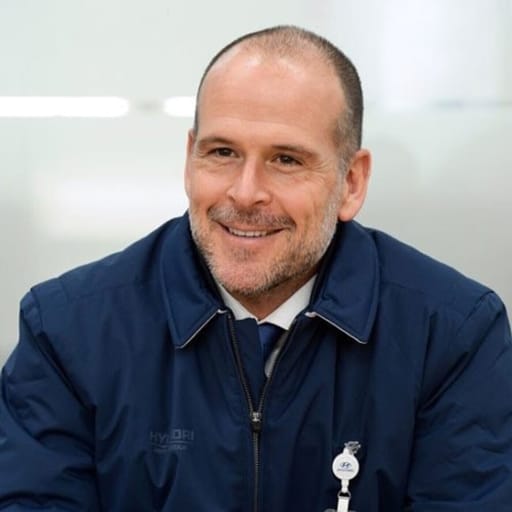
Transcript 0:00 [on-hold music] Welcome back to the Peggy Smedley Show, the podcasting voice of IoT and digital transformation. [on-hold music] Hello, listeners, and welcome back to the Peggy Smedley Show. 0:13 I'm coming to you live right now, this segment, at the NACV show, and, uh, we're really... It's been exciting. 0:20 I know you've been listening to the first two segments, uh, of the show, but now I've moved right over to Atlanta, and I am talking right now with Mark Ziegler, who's the vice president of Commercial Vehicles of R&D Strategy Group of Hyundai. 0:35 And Mark, welcome to the show. Hey, Peggy. Thanks for having me here. So Mark, I have learned some really exciting things that you guys are doing with Hyundai, and I'm pretty excited to talk to you about some of them. 0:46 I've learned more about what Hyundai is doing right now and some new exciting things. 0:51 But I'm gonna start off by having you explain them because I'm starting to be discovering that I'm getting to be a nerd, and I think Hyundai is making me the nerd because I wanna understand and let you explain what is the Hyundai Neptune concept, because it's pretty exciting stuff. 1:06 Yeah. So actually the, the Hyundai Neptune concept is a truck, um, it's a truck which doesn't use diesel. So we're talking here about, uh, emission-free driving. 1:14 And emission-free driving can be done either with battery electric vehicles or with fuel cell electric vehicles. And the Neptune is a fuel cell electric truck, uh, with a special new design. 1:24 Uh, I would call it a global design. And when you say, uh, at first it... But it's a, a truck now. You know, I've, I've never really covered a whole lot of trucks. 1:34 Now, I'm starting to get into covering trucks, but I've covered, you know, autonomous vehicles. 1:38 But what's exciting about this is it's hydrogen-only concept that you've got coming out here, and that's what you're talking about. But I think what's interesting is what you're trying to do with this. 1:48 So talk a little bit about what Hyundai wants to do, because what I like what Hyundai is doing here is it's talking about a concept here and trying to get new partners here, I think, and as a concept car or truck, I should say, here in the States, and really trying to find innovative partners and startups. 2:06 And I think that's where I get excited because I think you guys are thinking outside the box and I think are doing things differently than, I think, other companies. Talk to me about that. Well, okay. 2:16 May-maybe I have to explain it a little bit more in detail. See, that's where the nerd of me comes out, right? [laughs] Okay. Yeah. Uh, so, so actually we already have hydrogen fuel cell vehicles already on the road. 2:27 We have passenger cars, uh, working with fuel cells, and we have also trucks and buses working with fuel cells. But this is in Europe and in Asia especially. 2:36 So the reason why we are here now on this, uh, on the show and, and showing a concept truck is because we wanna get some feedback if this truck design is also acceptable here in the States. 2:47 So you, you have the so-called conventional trucks. So a conventional truck has this big nose, the big engine hood, and our concept truck that you have seen, uh, here doesn't have this engine hood anymore. 2:58 It looks more like, I don't want to say European style, but some-somewhere in between. And we have to know if there's a customer acceptance for such a new, uh, design. 3:08 It looks to me now, maybe I'm just looking at it, it looks like a train. You know, it has these really kind of concept. It's really... It, it reminds me of the old look and a new look. It's very, uh, edgy. 3:18 It's really creative. Yeah. 3:20 And, and it's, uh, it's a good reason for look-- that it look like a truck, uh, or like, like a train because, uh, even if this is, uh, an original train, uh, was, was the example for, for this, uh, design, uh, this bullet train is the most aerodynamic shape you can find. 3:36 I mean, if you look from the side, it even could be like, uh, an airplane wing. So we have the most, uh, aerodynamic shape, uh, that you can get onto a truck. 3:45 So when you guys were coming up with this concept, I mean, and you were thinking of bringing it here to the States, what do you hope to achieve? 3:53 Are you hoping to educate people on just in general what you're trying to achieve? Are you hoping to really get people to understand the long-term strategy that you can change the way... 4:03 We, we have to think about sustainability. We have to think about green, but we have to think differently. Is that what you're saying? 4:09 Look, we can do things totally different and, and you're doing it already, and that the States need to think about things differently. Well, I would say it's less about, uh, education. 4:18 Uh, um, I mean, that's, that's the [laughs] the role of, of the teachers in, in the world, uh, to, to educate the, the children and, uh, about the necessity of CO₂ reduction, about the necessity to do something against global warming, which, which is, uh, simply a fact. 4:34 So our, our main intention being here is, uh, actually to, to talk to possi-possible customers, to energy providers, 4:42 uh, to, to dessication companies, to set up a, a consortium, an association, uh, to get to a, a business case to make this possi- technology really a profitable business case. 4:54 Because what we don't want to do is just like, say a, a greenwashing attempt. You know, so just showing one prototype and, and telling we are green. This is not being green. 5:04 Being green is really the changing, changing the business, changing with hundreds and thousands of trucks who are not-- or which are not polluting the environment anymore. 5:14 So do you think that we're able to achieve this or do you think this is gonna take governments, it's gonna take businesses? Who's gonna really be able to make this happen? 5:22 Because it seems like there's a lot of effort to push this forward. Yeah. Everybody has to be involved. That's clear. So in Europe, we have strong le- regulations, uh, which favor this kind of technology. 5:33 So like, uh, the first, uh, one thousand six hundred trucks we are applying in Switzerland, in the middle of, of Europe, uh, and they have a really high highway tax, so up to one dollar per kilometer driven. 5:44 And, uh, with an eco-friendly vehicle like our trucks, you can omit these highway taxes, which is easily eighty thousand dollars a year. Now, this business case might look different here. 5:54 We don't have these high highway taxes here, but maybe we have the chance of lower energy costs to produce hydrogen, uh, maybe the... Or not maybe. We have the bigger players here. 6:04 We have huge fleets here, which actually have a business case. Because they have so many vehicles, they have a business case for building up their own refueling station. 6:12 And that's our main intention, talking to customers, big fleets, also talking to drivers if they like this concept.Talking to all kind of partners to, to get into this green technology. 6:24 So realistically, how long is it gonna take to make this happen? Because nothing happens overnight. It's gonna take some time. Yeah. 6:32 So, so in, in other countries we are already doing it, yeah, and it's, it's a fast, very, very fast change. 6:38 And many, and many of our friends and competitors also announced that they are completely changing over to electrified vehicles. So it's, it's, it's starting right now. 6:47 Now, if you ask me about the timeline in the US, uh, that's exactly why we are here. That's what, what we have to figure out. 6:54 What, what, uh, what are the legal regulations, what are government grants, what, uh, what are energy, uh, costs and so on. 7:01 So there's a lot of parameters which we have to take into account to figure out when is the right time to start with what kind of technology in which space. 7:11 So looking at that right now, putting everything together, putting all of the things into place, are we talking about this is something that when we look at autonomous vehicles, looking at everything, we're talking about within the next five to ten years? 7:25 Well, it, it depends, uh, also, uh, we don't know what the legislation is going to be like. I mean, that's more long-term things from the, from the legislation. 7:33 More interesting is from the technology perspective, how fast are we going to get a profitable business? Because in the States it's all about money, basically, and I mean this in a positive sense. 7:44 If we find a, a business case which makes this vehicle, uh, operating cheaper than diesel, and there are chances for, for, to, to do this, uh, then the change will come pretty quick. Let me add one more thing. 7:56 On the long-term view, if the government figure out that they cannot operate, uh, all the, the energy-consuming, uh, uh, operations with, with oil, if they go to renewable, uh, resources, then they have to find a way how to store energy, because wind and solar is not constantly produced. 8:15 It's not produced when you really need it, so then you have to store energy, and the only way to store energy is via hydrogen. 8:22 So the first countries like Japan and, and Korea, they are changing over now to this hydrogen society and thinking about and, and starting to build up the infrastructure to store hydrogen, which then can be used very easily in our vehicles. 8:37 Well, I have to tell you, Mark, from a technological standpoint, it makes sense. From a business standpoint, it makes sense. 8:43 But the one thing you said, it takes government and it takes a lot of money, and it takes a lot of people to think about it. Now, you're talking about the United States. 8:50 They can't seem to get their act together on a whole lot of things, so that's gonna be the problem. But I hope... I wish you guys the best of luck. 8:57 You guys, you can learn more about what you guys are doing at hyundai.com. Thank you so much for spending time with me today. Thanks, Peggy. See you. All right, listeners, we're out of time for this segment. 9:05 Remember, you can check us out. We are broadcast live every Tuesday at twelve PM Central. And you can tweet at us and check out what's going on at ConnectedWMag, and check out all the new things that we're doing. 9:16 There's some great things up there. Check out The Peggy Smedley Show at thepeggysmedleyshow.com. And as always, check out what's going on with this great news. 9:24 As always, this is The Peggy Smedley Show, y- and y- and you can... the podcasting voice of IoT and digital transformation. Remember, with great technology comes great responsibility. 9:36 [rock music] Constructek TV, your fierce advocates for construction. 10:04 Constructek TV digs into infrastructure, drills into global economic conditions. 10:10 It is changing the talent gap narrative, adopting a new vision and a voice to the new skilled worker in construction, all with the help of technology. 10:20 Constructek TV, everything you need for infrastructure, labor, and technology. Like, share, and subscribe to Constructek TV at youtube.com/constructektv. 10:35 Besides the hard work of our incredible WS Radio staff that has decades of experience in the broadcast industry, one of the reasons WS Radio sounds so good is we use Orban technology. We are not alone. 10:47 Over fifty thousand professional broadcasters can't be wrong. From radio, TV, streaming to hardware and software, Orban has been supplying the broadcast industry for nearly thirty years. 10:58 Great customer service and continued R&D separates Orban from the rest. Learn more at orban.com. I've heard this is, like, one of the best pizza spots in town. Yes, it is. 11:08 I'll do a slice of pepperoni, slice of vegetarian. You got it. And I will pay for all of that in three days. In three days? [laughs] What's that mean? Well, wait, you accept credit cards. 11:17 That money's not gonna hit your account for three days anyway. I need my money quicker. At Chase, we hear you. With Express Funding, card payments are in your Chase account the next business day. 11:25 Go to chase.com/expressfunding. Chase for Business, so you can. Compensated participation. All businesses are subject to credit approval. 11:31 Not all clients are eligible for next business day funding, and additional terms, conditions, and restrictions apply. [upbeat music] IoT is here. 11:39 AI and machine learning are catching on, and they are all changing our world. But what's next? How will you be impacted? Let The Peggy Smedley Show keep you up to date and looking ahead for your business. 11:51 Tune in every Tuesday at noon Central Time at peggysmedleyshow.com. 11:57 [upbeat music] If you heard that sound, you probably are eligible for insurance from Navy Mutual, insuring the men and women of the Navy, Marines, and Coast Guard. 12:07 Here's what one policyholder, retired Navy commander Thomas Dade, had to say. "Navy Mutual is the best insurance decision I ever made. 12:14 I wish you had a savings plan available that earned the rates my Navy Mutual insurance has been earning." 12:19 Navy Mutual Aid Association, started by military members in eighteen seventy-nine, serves active, reserve, and retired military today. 12:27 Navy Mutual honors our military by providing them affordable life insurance with the features they need without fine print, sales fees, or military service restrictions. 12:36 Value, integrity, trust, and stability are the cornerstones on which our commitment to you and your loved ones are built. 12:44 Call Navy Mutual at one-eight hundred-six-two-eight-six-zero-one-one or navymutual.org for your personal life insurance plan consultation. One-eight hundred-six-two-eight-sixty-eleven or navymutual.org. 12:55 Navy Mutual, ensuring those who serve.