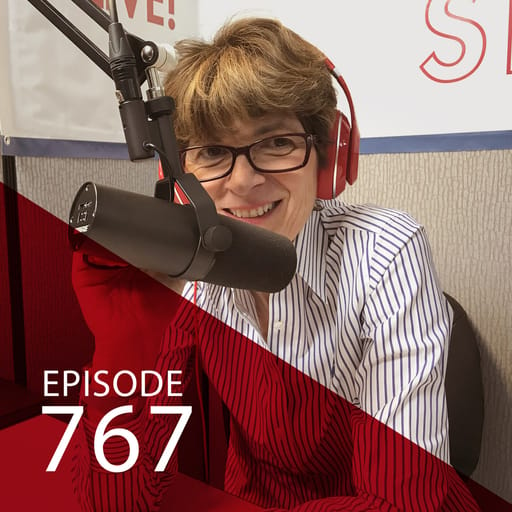
Transcript 0:00 [gentle music] I have to believe there are solutions for all of this lies in our technology. There's a lot of really smart people out there who are making some really great solutions. 0:13 Our technology can help eliminate waste. It can help heighten efficiencies and productivity, and we know that. We've seen it, and we're seeing it every day. 0:24 [upbeat music] Welcome to The Peggy Smedley Show, your voice for our connected world, with your host, Peggy Smedley. 0:42 Hello, listeners, and welcome to today's edition of The Peggy Smedley Show. I'm your host, Peggy Smedley. Friday, April twenty-second, is Earth Day. 0:52 So for the first segment, we will talk all about sustainability and circularity in our businesses. I'll talk about one specific vertical on the segment today, and that's food and agriculture. 1:06 Over on the blog tomorrow, I'll be narrowing in on fashion and retail. 1:12 These are just a few specific examples, but my hope is, is that we'll help all businesses understand the importance of our carbon footprint and how we can become more sustainable and circular in all areas of our businesses. 1:28 Also, make sure to stick around for the end of the entire segment, as we're gonna be doing kind of a fun challenge and a quiz at the end. So I hope you'll stick around for it. 1:38 But later on in the show, I'm also gonna be interviewing, as always, some amazing guests. I'll be talking to Ramesh Srinivasan, who's the professor at UCLA's Department of Information Studies. 1:51 And then I'm gonna wrap up the show with Andy Binns, co-founder of Change Logic. So stick around, as always. There's some amazing discussions we're gonna have today. So let's get started. 2:03 Our food system is rapidly deteriorating the planet. If we continue, we will not be able to feed the more than nine billion people on the Earth in twenty fifty. 2:16 We are seeing a growing population with food insecurity, and what we are eating is pushing the planet faster and faster to climate change and deforestization. 2:29 So then I have to ask you this: Do you know what your food print is? A food print measures the environmental impacts associated with the growing, producing, transporting, and storing of our food. 2:46 We are talking about all the resources consumed throughout the entire food supply chain. Today, there is a global movement to reduce our food prints. 3:01 Over at earthday.org, there is a calculator to actually find out how your meals impact the planet. There's also an eco-friendly recipes if you wanna look at them. 3:14 Perhaps one of the best ways to become more sustainable with our food is throughout the entire supply chain and in agriculture. So I think it's good for us to look at a couple of these right now for this segment. 3:29 So today, agriculture is facing a myriad of challenges. For one, soil capacity is dramatically declining. Some experts predict fewer than sixty harvests remain. 3:43 The United States is losing soil ten times faster than it is replenished. The l- solution comes in the form of regenerative farming. 3:55 At its core, regenerative agriculture can reverse climate change by building soil, organic matter, and restoring degraded soil biodiversity. 4:09 Specifically, it is a holistic land management practice that leverages the power of photosynthesis in plants to close the carbon cycle. 4:21 Some regenerative pla- practices include no-till farming, cover crops, crop rotation, managed grazing, and composting. Now, these are just a few, but you overall get the picture of what I'm trying to describe here. 4:38 My point overall is that th- all of this promotes the health of degraded soils by restoring their organic carbon. It also sequesters atmospheric carbon dioxide. 4:54 The result is a healthier kind of soils, crop resilience, and nutrient density. 5:01 Now, if we wanted to look beyond soil and crops, animal agriculture is estimated to account for up to eighty percent of all global anthropic greenhouse gas emissions. 5:18 Now, I had no idea until I started researching for this segment, in the United States alone, there are more than ten billion animals slaughtered for food annually. 5:30 The average American consumes more than two hundred pounds of meat every year. Now, think about that. Producing meat is a resource intensive, too, and this is what's so interesting. 5:43 An estimated eighteen hundred gallons of water goes into a single pound of beef. With that much water, you could take a hundred and five eight-minute showers. 5:56 Animal agriculture is also a leading cause of deforestization. This leads me to my opinion for today. We have a few solutions here.We can maybe eat less meat, sure. Okay, we all get that. 6:12 But we all know there are the other things we need to really discuss. But all of that's for another day. I don't wanna get into eat less meat and all these other kinda topics. 6:22 But what we can do is implement cutting-edge technologies in our businesses and in our supply chain to be more innovative, sustainable, circular. We can use tools and systems to help reduce food loss and waste. 6:39 We know one-third of edible food produced for human consumption is lost or wasted each year. There's people starving, but we waste so much. Much of our food loss takes place before it even reaches any of us as consumers. 6:58 Sadly, this is due to problems in, in, in improper farming techniques, storage, packaging, processing, all of these things, and also food loss and waste accounts for roughly 8.2% of the total human-made greenhouse gas emissions. 7:20 I have to believe there are solutions for all of this lies in our technology. There's a lot of really smart people out there who are making some really great solutions. Our technology can help eliminate waste. 7:35 It can help heighten efficiencies and productivity, and we know that. We've seen it, and we're seeing it every day, and it can create a carbon footprint or a food frip- footprint that is actually sustainable, circular. 7:53 It can do so much. Now, here's my tip. Consider joining our challenge this week. This is what I wanna encourage you. I think this is kind of fun. 8:02 Yesterday on the blog, I challenged you to do something a little bit different. I asked you if you would take the Living Lab pledge, and here's how it works. 8:16 Do something unique each day this week that will be beneficial for our environment. It could be something small each day or something big, w- whatever you wanna do. But the idea is do something. 8:33 I mean, when you do something, share it on social using the hashtag LivingLabPledge. That's what I wanted everyone to do. I, I share some ideas like planting a tree. 8:46 We're doing a lot of those in the Living Lab site right now. Riding your bike instead of driving your car to work. Switching off your faucet while brushing your teeth. 8:58 I mean, there's a lot of wasted water that you don't even realize when you get up to just brush your teeth. Picking up garbage that you see on the road. 9:08 We, we walk right past things or-- and we don't even wanna do it, but we see it every day. I mean, think about what you could do, or taking our quiz. I love this. I really love this. 9:21 In our businesses, we can also come up with ideas for how to be more circular and sustainable. I would love for you to tell me. Tell me what you are doing this week using the hashtag LivingLabPledge. 9:40 You know, make sure to take our quiz. I mean, I think it's exciting to see how much you know. 9:46 The quiz is over on our blog at connectedworld.com, and it, it would be interesting to see if you are able to do it, but it can be read through questions for all of us, and h-here, here it is as well. 9:59 So if you know the answers, tell them to me on social media and use the hashtag, again, the LivingLabPledge. So here are the questions. I'm gonna give you the questions now, so if you haven't seen them. 10:12 When was the first Earth Day? How many of you know that? When did Earth Day go global? How many of you know that? Now, this one's really interesting as well. 10:27 How many individuals have taken the action? Very interesting question, right? How many countries are engaged in Earth Day today and getting involved in it? When did it start? 10:45 When did it all begin? Again, if you know any of these answers, use the hashtag LivingLabPledge and tell me now. I'm really excited. 10:55 Now, I'm gonna share all the answers on my blog later this week and let you all know and see how well you're doing. Now, don't go up to Google to find the answers, you know? Be bold. Be honest. See if you know. 11:07 One last thing before I go. I wanted to, uh, draw your attention to a few new things we have going on here at Specialty. Uh, earlier this month, we launched our new Project Sustainability podcast. 11:21 It is the place for all things green, and every Wednesday it brings listeners along on the journey to use technology to reduce energy consumption, save a bit of money, and live in a, a healthy home. 11:36 That's what we're really trying to do. Our, uh, on the inaugural episode, Eric Burnell of Elite Water Systems joined me to talk all about water, and it's really a great discussion. 11:49 It's a month-long discussion with a guest host who co-hosts with me, and I think if you haven't had a chance to listen to it, make sure you check it out because it's really, really a great discussion, and we dive really into some deep discussion about water. 12:09 We also have launched a new Instagram called pspgreen, so follow me there. I'd love for you to do that. Uh, we're posting all kinds of things. 12:17 I'm posting some new challenges up there, and there you can watch the Living Lab unfold. 12:23 We've been, uh, taking a lot of video up there and posting things, all kinds of things that are happening at the Living Lab, and we want you to all learn about how we can do some of these things together, and all of it's about how we can live a healthier life, not only in our businesses, about sustainability and circularity, but the idea is what do we need to do? 12:45 How do we become more energy efficient? 12:47 Sometimes we hear about these things, but it gets, uh, to be a little bit more trickier than we think, but these are really truly exciting times for all of us, but sometimes they're more challenging than we think. 12:58 So it's, it's fun. The next, uh, set of podcasts that we're gonna have on Project Sustainability will be talking about air, all the contaminants that are in our air. 13:07 And well, everything's going on in the Living Lab, and I hope you'll follow us there. As always, if you have thoughts on what I've talked about today, please send me a tweet to continue this discussion. 13:18 Now I want you to take the pledge on Earth Day, though. Put them up on Connected World, and we wanna know everything that you're thinking about. All right. That's all the time we have for this first segment. 13:27 Please check out our website at connectedworld.com, our show website at thepeggySmedleyShow.com. But don't go away because I'll be right back after this commercial break. 13:37 As always, this is The Peggy Smedley Show, your voice for our connected world, and remember, with great technology comes great responsibility. [upbeat music]