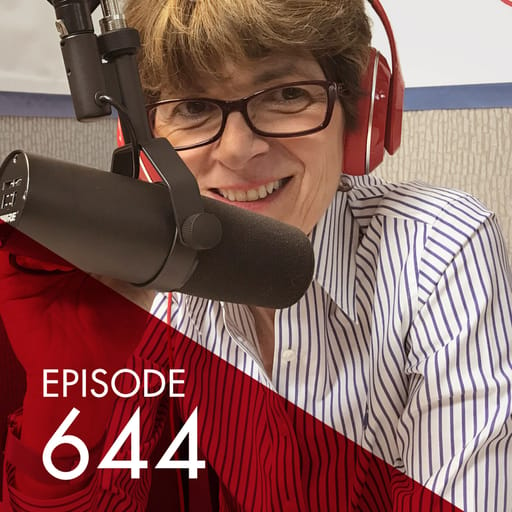
Transcript 0:00 [on-hold music] Yes, manufacturing is in a slump, and yes, that's unfortunate. 0:07 But there are also some really great innovation happening in manufacturing right now, and it's up to manufacturers to look at ways that you can leverage technology to get past the traditional manufacturing hurdles. 0:20 [upbeat music] Welcome to The Peggy Smedley Show, the podcasting voice of IoT and digital transformation, with your host, Peggy Smedley. 0:35 Hello, listeners, and welcome to today's edition of The Peggy Smedley Show. As always, I'm your host, Peggy Smedley, and what a great day to be on the radio. 0:44 You know I, I'm excited because I'm talking about the supply chain and how complex it is. And this month we're looking at the different components of it. But why I'm really excited, you know what we're looking at? 0:56 We're gonna focus on manufacturing, one of my favorite subjects, something I know quite a lot about because I wrote a book on it and I have a lot of insight in it, and I wanna share a lot about it with you today 'cause I think there's a lot of excitement in it, and I'm gonna tell you why. 1:10 Um, but I'm gonna share this with you, and it's gonna make you a little confused because the latest ISM Manufacturing Index came out, and it showed another month of contracting economic activity in the manufacturing sector and... 1:23 But the outlook isn't completely dreary, and I'm gonna explain to you why. 1:27 Because I want you to stick around as we kinda highlight some of the innovative startups that are picking up manufacturing, and they're gonna give us some great hope for twenty-twenty and beyond and that whole new decade. 1:39 But before we get to that, I wanna tell you who we're gonna be talking to today. I've got David Closs, the John H. 1:46 McConnell Chair Emeritus and Chair Emeritus of the Department of Supply Chain Management at Michigan State University. 1:53 And then I'm gonna wrap up the show with Charlotte Blank, the Chief Behavioral Officer of Meredith, who-- to talk about what it means to lead like a scientist. So we got a great show, so stick around. 2:07 We got a lot to talk about. So earlier this month, as I said, ISM, the Institute, uh, for Supply Chain Managemen- Management, came out with the November twenty-nineteen manufacturing report. 2:19 And I know if you're in manufacturing, you pay attention to this. And if you're not familiar with it, it is the key index for measuring the status of the manufacturing space. 2:30 And ISM's report showed that economic activity in manufacturing, in the manufacturing sector in general, contracted in November, even though the overall economy grew for the hundred and twenty-seventh consecutive month. 2:46 So the November index registered forty-eight point one, a decrease of, uh, zero point two percentage point from the October reading. Now, in fact, November was the fourth consecutive month of contraction. 3:01 Now, let me break this report a little bit for you, for those of you who may or may not be following what's going on directly in manufacturing. 3:09 New orders contracted, as did employment, inventory, uh, customers' inventories, backlog of or, or orders, and new export orders. 3:20 Now, when you put all that together, the biggest contractions between October and November came from inventories, which decreased three point four percentage points, and customers' inventories with a two point eight percentage point reduction. 3:36 So I think the third biggest drop was the new export orders, and other categories like production and supplier deliveries actually gained percentage points in November. 3:49 So prices and imports also registered increases in November. 3:54 Unfortunately, when you zoom out and you look at the overall trends and not just the monthly fluctu- fluctuation between October and November, the trends suggest that manufacturing overall is contracting. 4:11 So though ISM labels the overall economy as growing, each of the indexes tracks within manufacturing are labeled as contracting, slowing, too low, or decreasing based on ISM's monthly data. 4:25 So ISM's respondents cite issues like global trade uncertainties, economic uncertainty in general, and trend changes as reasons for the downward trend. 4:37 So as I see it, tariffs and continued confusion, I think about trade, and I look as kind of held manufacturing down, kind of kept everyone a little bit feeling uneasy. 4:51 So you may be wondering, "What should we do with all of this information?" Now that I've given you all the bad news, right? And you look at these numbers and you go, "What the heck?" Right? 5:01 If you're in manufacturing, here's what I would suggest you do. Here's someone who's been looking at this space for twenty-five years, and you say, you know, if you are in manufacturing, you should be cautious. 5:12 I'm gonna tell you right off the bat, you should be cautious. But I still believe you should be overly optimistic and have an overly optimistic approach to your planning for twenty-twenty. 5:25 And here's why I'm gonna give you that. I know that ISM's data is showing a growing economy. But if you look at all of this, many of the same challenges manufacturers faced this year are gonna persist in twenty-twenty. 5:40 We get that. But perhaps the really good news in all of this, though, is that some of them may begin to lessen over time as the political climate changes after the presidential election. 5:54 Now, we all know presidential elections and election time creates a lot of havoc, and, and it's not surprising, and, and all of you have been watching it, uh, you know, play out on television right now.What's more, if history is any indication, it's hard to know when these corrections will happen. 6:12 We all are aware of that because we've been watching it. But as an optimist, I like to believe that manufacturing can do anything, and we've seen it do anything. 6:22 So cash flow planning is going to be really important for any of you in manufacturing. 6:26 And depending on your sector, you may need to take a second or third look at your capital spend plans for the next year based on what trends you're seeing. I also think you need to be looking at technology. 6:38 I always say technology, technology, technology, because how can technology help you streamline? It can help you be kind of smarter in business. 6:47 I think, you know, people, process, technology all need to come together, and you hear me say that a lot because during times of economic contraction, we need to kind of lean on technology to help all of us do more with less. 7:02 So you need to have the right vision, and with the right vision is optimism, and that means anything is possible. 7:11 And as I, I mentioned at the top of the segment, I don't want you to be fearful of the future or think all of this is doom and gloom, 'cause I think right now you're probably thinking that. 7:20 But there are some really exciting things going on in manufacturing right now that make me feel very optimistic about the, what the future holds and looking forward for 2020. 7:30 And I've always said I believe in innovation, I believe in the innovators, I believe in the great minds, and let me kind of look at a few innovative startups that I think are influencing the in- the manufacturing space that are the reasons why I have so much hope. 7:45 One company is called Fortify, which was founded by Randall Erb and Joshua Martin after they spent I think a lot of time researching composite 3D printing during their time at Northeastern University in Boston. 8:00 And aiming I think kind of, and as I looked and did some research on them, to make some quick, seamless fabrication of composites with optimized microstructures. 8:10 The two kind of really great entrepreneurs are now leveraging this technology to shorten lead times and improve upon the quality of materials used in traditional manufacturing. 8:22 And again, this is how you get smarter within manufacturing. So Fortify's FluxPrint technology uses a patented magnetic 3D printing process that produces composite parts with ideal m- m- mechanical properties. 8:37 Now, this is pretty cool stuff, and you wanna check out their website for more details. Go up to 3dfortify.com, and you could see really what they're doing. It's pretty cool. 8:46 So it's exciting to hear about young ent- entrepreneurs applying innovative n- n- kind of na- natures to problem and solving all of this in manufacturing. 8:56 Another, uh, up-and-comer, and I'm gonna kind of do this fast 'cause I've only got a few minutes left, is Azule, which offers 3D manufacturing solutions. 9:05 And one common trade-off in manufacturing is speed for size and scale. 9:10 Now, Azule's HARP, they, they call it the High Area Rapid Printing technology, addresses kind of this trade-off dilemma, and what they've done is if you could have limitless scale, limitless materials, high throughput, and still be fast. 9:26 Now, I think this is really cool. I mean, I think I'm, I'm geeking out right now because I think what they're doing is really neat. 9:33 And Azule says its innovative technology offers unri- unrivaled scale and speed as a result of unrivaled throughput. That's what manufacturing's all about. 9:44 So I think it's a really interesting concept and one that could change how we manufacture goods. 9:50 Now, in Europe, 3DHubs, an Amsterdam-based startup, is offering an online manufacturing pr- platform that's really growing as well, and what I like about this one is this company just announced last week that it's expanding in France. 10:04 And 3DHubs is interesting because it provides on-demand access to a global network of manufacturing facilities. To me, this is a product of what the connected world we live in is all about. 10:16 We don't just work in isolation anymore. There's no need to reinvent wheels, so to speak, when we have access to so much knowledge and have so many different ways to gather that knali- knowledge at our fingertips. 10:30 So here's my tip for today. 10:32 Yes, manufacturing is in a slump, and yes, that's unfortunate, but there are also some really great innovation happening in manufacturing right now, and it's up to manufacturers to look at ways that you can leverage technology to get past the traditional manufacturing hurdles. 10:49 So in this segment, I focused on data from the past that helps us understand the current market conditions and manufacturing and kind of project market conditions in the future, and we can leverage all of this to knowledge for the future. 11:04 But one wild card I think in all of this is going to take into account in this discussion is going to be the dawn of 5G. 11:12 5G I think is going to bring all these new capabilities and efficiencies to manufacturing, and it's going to be a game changer. 11:19 So once we add 5G to the mix, I think we can expect manufacturing to benefit in several different ways that will affect the economy's... 11:30 a discussion in a whole different way, and I think most people don't recognize that. 11:35 So I'm out of time, but let's connect on social to talk about this because I wanna hear what you think manufacturing can do, and 5G is gonna be that game changer that we don't think about when we add new materials and new mixes and speeds and feeds to all of this, I think for 2020 and beyond in the next decade. 11:54 So as always, this is The Peggy Smedley Show. Tweet at me at connecttoWmag. Tell me what you think. We're gonna be right back after this commercial break. 12:02 This is The Peggy Smedley Show, the podcasting voice of IoT and digital transformation. And remember, with great technology comes great responsibility. We'll be right back. Go get that quick cup of coffee. [upbeat music]